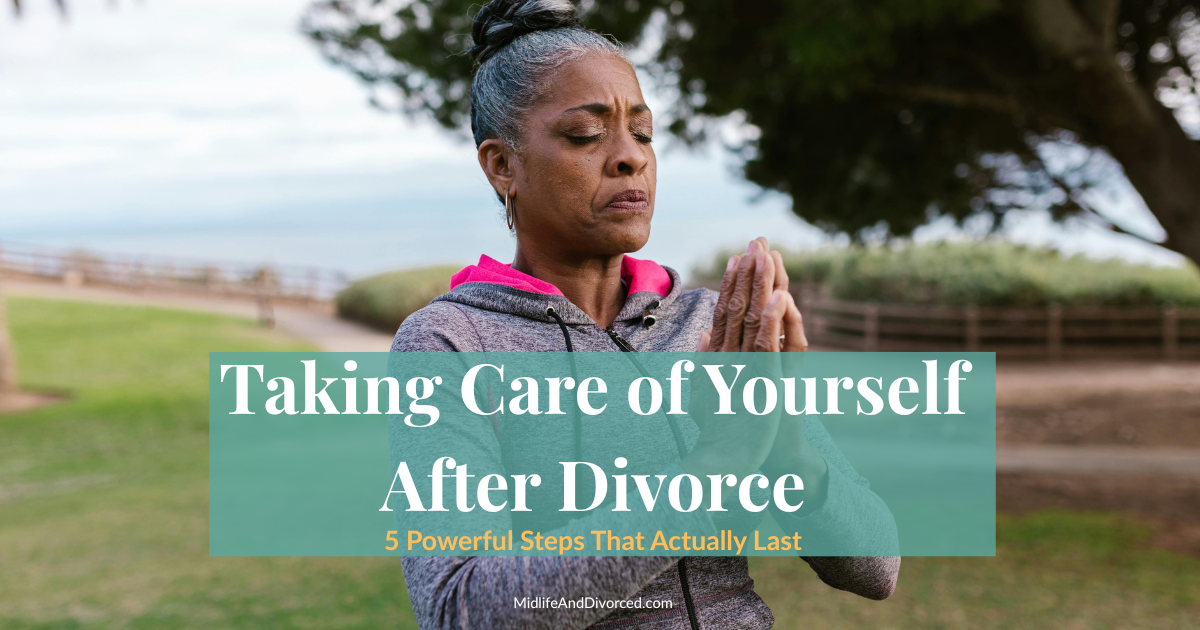
Taking Care of Yourself After Divorce: Why This Time Has to Be Different
TLDR
Taking care of yourself after divorce is not optional — it is the foundation everything else is built on.
After a divorce, most women know they should take care of themselves. Fewer actually do it — and even fewer make it stick. This article explains why self-care after divorce is not a temporary response to pain, but a permanent shift in how you relate to yourself. It covers what getting back to basics actually looks like, why it matters more than most people admit, and how to make it a lifestyle rather than a phase.
Taking care of yourself after divorce sounds like obvious advice. Eat well. Move your body. Sleep. Get back to the things that were yours before the marriage.
You already know this. And yet.
In my clinical work with women navigating divorce, I have observed something consistent: the women who struggle most in the months after separation are almost never struggling because they lack knowledge about what would help them. They are struggling because the pain of what happened has made basic self-care feel either impossible or irrelevant.
This article is not going to tell you to take bubble baths and practise gratitude. It is going to make the case — as directly as I can — for why returning to the basics of your own physical and emotional health is the single most important thing you can do right now. And why this time, it cannot just be a phase.
What “Getting Back to Basics” Actually Means
When a marriage ends, the structure of daily life collapses along with the relationship. Routines that were organised around another person — meals, schedules, sleep patterns, social life — suddenly have no anchor.
Getting back to basics means rebuilding that structure around yourself.
It means eating at regular intervals, not because you feel hungry — you may not, for weeks — but because your body needs fuel to process what it is going through. It means moving your body consistently, not to lose weight or look a certain way, but because physical movement is one of the most effective and accessible tools for regulating the nervous system during acute stress. It means sleeping — and taking seriously the things that are disrupting your sleep, whether that is anxiety, racing thoughts, or the simple shock of an empty bed.
It also means returning to the things that were yours before the marriage. The interests, friendships, habits, and activities that existed before you built your life around another person. These are not distractions. They are reminders of who you are outside of the relationship — and right now, you need those reminders.
The Pattern I Have Noticed — And What It Means
There is something I have observed repeatedly in my work with women going through divorce, and it is worth naming directly.
In many of the cases I have worked with, one of the earliest signs that a marriage was in serious trouble was that one partner had quietly started taking better care of themselves — getting fit, reclaiming interests, rebuilding independence — while the other remained static. This process sometimes unfolded over months, sometimes over years, before the marriage finally ended.
What this pattern reveals is important: the women who were actively working on themselves — even inside a struggling marriage — were already, on some level, beginning to locate themselves again. They were reconnecting with their own values, their own sense of what they wanted, their own capacity for a life that felt meaningful.
After the divorce, that same energy is available to you. The difference is that now, you can direct it entirely toward yourself — without guilt, without the friction of a relationship that was not working, without holding yourself back.
The question is whether you will use it.
Why Women Stop Taking Care of Themselves in Relationships
This is worth understanding, because it is not an accident.
Many women gradually deprioritise their own health, interests, and independence inside a long marriage — often without fully realising it is happening. The relationship becomes the primary structure. His schedule, his needs, his preferences shape the household. Her own routines become negotiable in a way that his do not.
By the time the marriage ends, some women have spent years in a pattern where their own wellbeing was consistently treated as secondary. Getting back to basics after divorce is not just about recovering from the loss. It is about relearning — or in some cases learning for the first time — how to treat yourself as a priority.
That is not a small thing. It is one of the most significant shifts available to you in this period.
This Time, Make It a Lifestyle
Here is where most advice about self-care after divorce falls short: it treats taking care of yourself as a response to pain. Something you do while you are hurting, and then stop when things get better. When the next relationship comes along. When life gets busy again. When you have other things to focus on.
I want to offer a different framing.
The habits you build during this period — the exercise routine, the eating pattern, the sleep hygiene, the friendships you invest in, the interests you return to — these should not be a crisis response. They should be the foundation of how you live going forward. Not just for the next few months. For the rest of your life.
Because here is what I have also observed: the women who enter new relationships from a place of established self-care are fundamentally different partners than the women who enter new relationships from a place of emptiness looking to be filled. They bring something to the relationship rather than needing the relationship to provide everything. They maintain their own identity rather than losing it into someone else’s life again. They are, in the deepest sense, more available to love — because they are not dependent on love to function.
The work you do on yourself now is not just about surviving the divorce. It is about who you become on the other side of it. Taking care of yourself after divorce is not a reward
you earn when the pain is gone — it is the practice that gets you there.
Where to Start When You Have No Energy
One of the most common things I hear from women in the acute phase of divorce grief is this: I know I should be taking care of myself. I just cannot seem to make myself do it.
This is not laziness. It is a physiological reality. Grief and acute stress genuinely deplete the energy and motivation required to initiate new behaviours. The brain under sustained stress defaults to the path of least resistance.
So start smaller than you think you need to.
Not an hour at the gym — a ten-minute walk outside. Not a complete dietary overhaul — one meal a day that is actually nourishing. Not a full social calendar — one phone call to one person who makes you feel like yourself.
The goal in the earliest weeks is not transformation. It is momentum. A small action completed is the foundation for the next small action. Over time, those small actions compound into a life that feels like yours again.
The Connection Between Physical Health and Emotional Recovery
This is not incidental. The relationship between physical self-care and emotional recovery from divorce is well-documented.
Regular physical movement reduces cortisol — the primary stress hormone that remains chronically elevated during acute grief. It increases the availability of serotonin and dopamine, the neurotransmitters most directly involved in mood regulation. It improves sleep quality, which is itself one of the most powerful determinants of emotional resilience.
Adequate nutrition supports the same systems. The brain requires specific nutrients to produce the neurotransmitters that regulate mood and stress response. When those nutrients are absent — as they often are when grief disrupts appetite and eating patterns — emotional regulation becomes significantly harder.
None of this means that taking care of your body will make the grief disappear. It will not. But it will make you more capable of moving through it. And that is not a small thing.
FAQ
How do I start taking care of myself after divorce when I have no motivation?
Start with the smallest possible action — not what you think you should be doing, but what you can actually do today. A ten-minute walk. One nutritious meal. A single phone call to a friend. Motivation follows action more often than it precedes it. Begin before you feel ready, and let the momentum build from there.
Is it normal to neglect self-care after divorce?
Yes, and it is extremely common. Grief depletes the energy and motivation required to initiate self-care behaviours, and the structural collapse of daily life that accompanies divorce removes the routines that previously supported them. This is not a personal failing — it is a predictable response to an enormous loss.
Why does exercise help with divorce recovery?
Regular physical movement reduces cortisol, increases serotonin and dopamine availability, and improves sleep quality — all of which directly support emotional regulation and resilience during acute grief. It also provides a sense of agency and accomplishment at a time when much of life feels out of control.
How do I make self-care sustainable after divorce?
The key is to treat it as a permanent shift rather than a temporary response to pain. Build the habits during this period with the intention of carrying them forward — into whatever comes next, including any future relationship. The goal is not to take care of yourself until you feel better. It is to take care of yourself as a way of life.
What if I have children and no time for self-care?
Self-care for mothers going through divorce does not require significant blocks of uninterrupted time. It requires intentionality about small, consistent actions — movement built into the day, nutrition that does not require elaborate preparation, connection with supportive people in whatever form is available. Taking care of yourself is not separate from taking care of your children. It is what makes you capable of doing it well.
Disclaimer
This article is for informational and educational purposes only. It is not a substitute for individual therapy or professional mental health support. If you are experiencing a mental health crisis, please call or text 988.
Sources
- Fisher HE et al. Reward, addiction, and emotion regulation systems associated with rejection in love. Journal of Neurophysiology. 2010. PMID: 20445032. https://pubmed.ncbi.nlm.nih.gov/20445032/
- Profiles of Psychological Adjustment to Divorce and Separation. PubMed. 2024. PMID: 40673345. https://pubmed.ncbi.nlm.nih.gov/40673345/
- Desired attachment and breakup distress relate to automatic approach of the ex-partner. PubMed. 2021. PMID: 34923372. https://pubmed.ncbi.nlm.nih.gov/34923372/