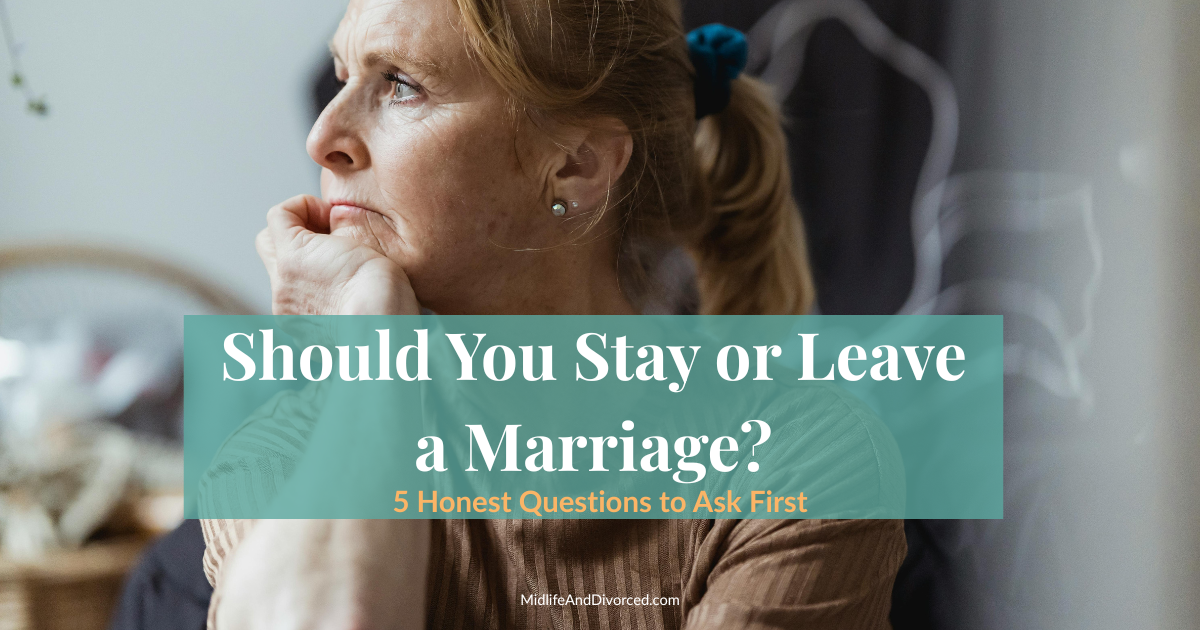
Should You Stay or Leave? 5 Honest Questions to Ask Before You Decide
TLDR
Deciding whether to stay in a struggling marriage or leave is one of the most difficult decisions a woman can face. Before you make it, there are five questions worth asking honestly — not to justify staying or leaving, but to make sure the decision comes from clarity rather than fear, resentment, or exhaustion. This article explores what it actually means to do the work on a relationship, and how to know whether that work is worth doing.
The question of should you stay or leave a marriage is one of the most difficult a woman can face. Most of the conversation around divorce focuses on leaving. On finding the courage to walk away. On choosing yourself.
That conversation matters. But there is another conversation that happens less often — the one about staying. About the courage it takes to look honestly at a struggling relationship and ask: have I actually done everything I can? Have I seen my own role clearly? Am I leaving because this is genuinely wrong, or because it has become genuinely hard?
In my clinical work with women navigating marriage and divorce, I have found that this question — stay or leave — is rarely as simple as it appears from the outside. And the women who make the decision with the least regret are almost always the ones who asked it honestly before they answered it.
Why This Decision Is So Hard to Make Clearly
When a marriage is struggling, the brain does something predictable: it starts building a case.
It begins to hyperfocus on everything that is wrong with your partner. It replays the arguments, the disappointments, the ways your needs have not been met. This is not a character flaw — it is a psychological mechanism. When we are in pain and considering leaving, we unconsciously gather evidence to make the exit easier to justify.
The problem is that this process distorts our perception. We stop seeing a full person and start seeing a collection of failures. We stop seeing a dynamic we are part of and start seeing a problem that belongs entirely to someone else.
This does not mean the marriage is worth saving. Sometimes it genuinely is not. But it does mean that the decision to leave — or to stay — deserves more than a case built by a mind that is already in flight mode.
Question 1: How Have I Been Withholding Love?
This is the question most women resist, and the one that matters most.
When resentment builds in a marriage, love does not disappear — it goes underground. We stop doing the small things we used to do naturally. We become careful, guarded, withholding. We tell ourselves this is self-protection. And in some ways it is. But it is also a form of punishment, and it creates a cycle.
Ask yourself honestly: when did I last show my husband genuine warmth without an agenda? When did I last do something small and kind simply because I love him? Have I stopped being curious about his life — his fears, his dreams, the things that matter to him?
I worked with a woman who came to me certain her marriage was over. She described her husband as cold, distant, and emotionally unavailable. When I asked her how she had been showing up in the marriage over the previous year, she paused for a long time. “I stopped trying,” she said. “I figured, why bother.”
Her withdrawal had created the very coldness she was now citing as evidence that the marriage was broken. This is not to say she was wrong and he was right. Both were contributing to the dynamic. But she had not seen her part of it clearly until that moment.
Question 2: Do I Know What My Partner Actually Needs?
Couples who have been together for years often know each other’s habits intimately — and each other’s inner lives barely at all.
They know how the other takes their coffee. They do not know what the other is most afraid of. They know the surface frictions. They do not know the deeper needs that are going unmet beneath those frictions.
What makes your husband feel loved — truly loved, not just tolerated? What makes him feel significant, valued, seen? What does he need from you that he has perhaps never been able to ask for directly?
These are not rhetorical questions. They are worth sitting with. Because a marriage cannot be evaluated fairly until both people have genuinely tried to understand and meet each other’s needs — not their own projection of what those needs should be, but the actual needs of the actual person in front of them.
Question 3: Am I Running From This Relationship or Running Toward Something?
There is a difference between leaving because you are genuinely incompatible and leaving because the relationship has become uncomfortable.
Discomfort is not evidence of incompatibility. In fact, the most significant emotional growth most people ever experience happens inside a committed relationship — precisely because intimacy confronts us with everything we have not yet healed. The fears, the patterns, the places where we do not yet love ourselves. All of it surfaces in a marriage in a way it never does when we are alone.
Ask yourself: if I leave this marriage, what specifically do I believe will be different? If the answer is “I will be free of this person’s flaws” — that is worth examining. If the answer is “I will finally have the space to become who I want to be” — that is also worth examining, because that space may already be available to you inside the marriage, if you ask for it differently.
This is not an argument for staying. It is an argument for honesty about what you are actually running toward. Asking should you stay or leave a marriage requires looking honestly at what you are moving toward, not just what you are escaping.
Question 4: Have I Communicated What I Actually Need?
At the root of almost every marriage breakdown I have worked with is a communication failure — not a compatibility failure.
Two people who stopped being honest with each other. Who began assuming the other should already know. Who started expressing their needs through withdrawal, criticism, or ultimatums rather than direct, vulnerable conversation.
Have you told your husband clearly and specifically what you need from him — not what he is doing wrong, but what would make you feel loved, safe, and valued? Not once, in an argument, but in a calm moment, with the intention of being understood rather than winning?
Most people answer this question with “I have tried to tell him.” What they mean is they have expressed frustration. That is different from communication. Real communication requires vulnerability, and vulnerability requires a willingness to be seen — which is genuinely difficult when you are also protecting yourself from being hurt.
Question 5: Am I Bringing My Full Self to This Marriage?
This is the question that is easiest to avoid.
It is common — especially in a struggling marriage — to begin finding aliveness outside the relationship. In work, in friendships, in hobbies, in anything that provides relief from the tension at home. This is understandable. But over time, it creates a quiet withdrawal that is devastating to a marriage.
When you come home depleted, guarded, and emotionally absent — and then evaluate the marriage based on how it feels to be there in that state — you are not evaluating the marriage fairly. You are evaluating what it feels like to be in a marriage with someone who is no longer fully present.
The question is not whether you have things outside your marriage that matter to you. That is healthy and important. The question is whether you are bringing the person those things light up — back home to your husband. Or whether home has become the place where you deposit whatever is left.
When Staying Is Not the Answer
Everything above assumes a marriage that is struggling but not unsafe.
If there is abuse — physical, emotional, or psychological — none of these questions apply. Safety is not a negotiation. If your husband is controlling, intimidating, or violent, the question is not whether you have communicated your needs clearly enough. The question is how to leave safely.
If there is a fundamental incompatibility of values — different visions for your life, irreconcilable differences about children, religion, or where you are headed — reflection and communication can bring clarity, but they cannot create alignment that does not exist.
And if you have genuinely done this work — asked these questions honestly, communicated directly, sought support through therapy or counseling — and the marriage still does not have what it needs to survive, then leaving is not failure. It is clarity. Ultimately, the question of should you stay or leave a marriage can only be answered honestly after you have looked clearly at your own role in what is not working.
FAQ
How do you know when to stop trying to save a marriage?
When both partners have made genuine, sustained efforts to understand each other’s needs and address the underlying dynamic — through honest communication, couples therapy, or structured reflection — and the fundamental conditions for a healthy relationship are still not present, that is usually the clearest signal. One person cannot save a marriage alone.
Is it normal to feel ambivalent about leaving a marriage?
Yes, and ambivalence is not a sign that you should stay. It is a sign that you are grieving something real. Most women who leave a marriage — even a genuinely unhealthy one — experience profound grief and doubt. That grief is about the loss of a future you believed in, not necessarily evidence that the decision was wrong.
Can a marriage survive if only one person wants to save it?
Rarely, in the long term. One person can initiate change and model a different way of showing up — and sometimes that shifts the dynamic. But a sustainable marriage requires both people to be willing to look at their own role and do the work. If one partner is consistently unwilling to engage, that unwillingness is itself important information.
What is the difference between a struggling marriage and a broken one?
A struggling marriage has the raw material for repair — two people who still love each other, who are willing to be honest, and who have not yet done the work of truly understanding each other’s needs. A broken marriage is one where the safety, trust, or fundamental compatibility required for repair is no longer present.
Should I try couples therapy before deciding to divorce?
If both partners are willing, yes — with a therapist who specializes in couples work. Therapy does not always save a marriage, but it almost always brings clarity. It can help both people understand the dynamic they have been caught in, which makes whatever decision follows — stay or leave — a more informed one.
Disclaimer
This article is for informational and educational purposes only. It is not a substitute for individual therapy, legal advice, or professional mental health support. If you are in an abusive relationship, please contact the National Domestic Violence Hotline at 1-800-799-7233 or text START to 88788.
Sources
- Profiles of Psychological Adjustment to Divorce and Separation. PubMed. 2024. PMID: 40673345. https://pubmed.ncbi.nlm.nih.gov/40673345/
- Desired attachment and breakup distress relate to automatic approach of the ex-partner. PubMed. 2021. PMID: 34923372. https://pubmed.ncbi.nlm.nih.gov/34923372/
- Fisher HE et al. Reward, addiction, and emotion regulation systems associated with rejection in love. Journal of Neurophysiology. 2010;104(1):51–60. PMID: 20445032. https://pubmed.ncbi.nlm.nih.gov/20445032/