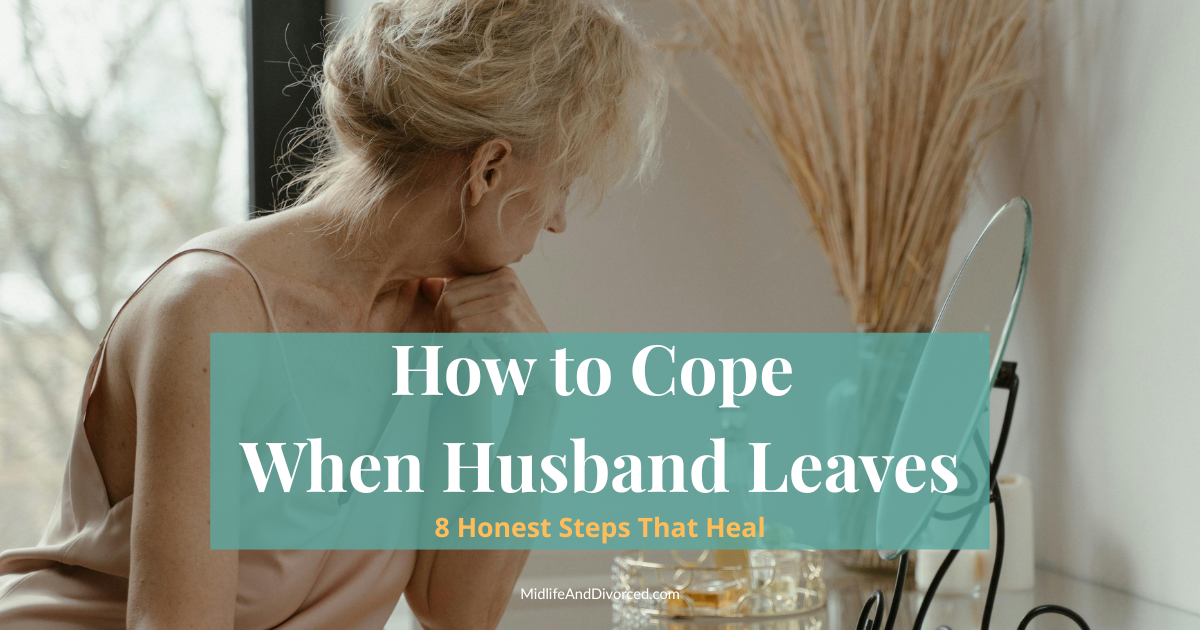
How to Cope When Husband Leaves: 8 Honest Steps That Heal
TLDR
When your husband leaves, what you are feeling is not weakness — it is biological withdrawal. The first 30 days are the hardest, and how you spend them shapes your recovery. This honest, science-backed guide answers how to cope when husband leaves with eight steps that actually help: from no contact and clearing your home, to a daily designated hour for grief, to rebuilding your social world from scratch. Closure does not come from him. It comes from you.
How to cope when husband leaves is one of the hardest questions a woman can face. The first thing you need to understand is this: you are not falling apart, you are in withdrawal. The pain you are feeling — the inability to sleep, the chest tightness, the obsessive replaying of every conversation — is not a sign of weakness. It is a measurable biological response to the sudden loss of an attachment your nervous system has depended on for years.
This article walks you through eight honest, science-backed steps that actually work in the first weeks after a husband leaves: how to stop the withdrawal cycle, how to protect yourself when your own instincts are working against you, how to give your grief a structure instead of letting it run your life, and how to begin rebuilding the parts of yourself that the marriage has quietly absorbed. Each step is grounded in clinical psychology and peer-reviewed research, and each one is doable starting today — even if today you cannot get out of bed.
1. Understand This: Your Body Is in Withdrawal, Not Weakness
The first thing you need to know is that the agony you are feeling has a name, and it is not “drama” or “weakness.” It is romantic withdrawal, and it is measurable in your brain. Brain imaging research by anthropologist Helen Fisher and her colleagues showed that when a long-term romantic attachment ends, the same neural circuits activate that we see in people withdrawing from substance addiction. Your brain has spent years — perhaps decades — wired to your husband’s voice, his footsteps in the hallway, the specific weight of him next to you in bed. When that input suddenly stops, your nervous system reacts the way a body reacts to any abruptly removed substance.
This is why so many women in their late forties and fifties describe identical symptoms: insomnia, nausea, no appetite or constant snacking, racing thoughts, a heaviness in the chest that feels physical because it is. Combined with perimenopausal or menopausal hormone shifts, the impact is amplified. Your cortisol is already elevated; grief floods it higher.
Knowing this changes everything. You are not broken. Your body is doing exactly what biology designed it to do when something it depended on is suddenly gone. The fact that it hurts this much is, in a strange way, evidence of how real your marriage was.
2. The 30-Day Reset: No Contact (or Minimum Contact for Co-Parents)
The single most important thing you can do in the first month is stop feeding the wound. That means no calls, no texts, no checking his Instagram, no driving past where he might be, no late-night emails you swear are “just to clarify something.” Every time you contact him — or absorb a piece of him through social media — you reset your nervous system back to day one of withdrawal. Thirty days of clean separation is the minimum your brain needs to begin recalibrating.
I know what some of you are thinking right now: “But we have children together. No contact is impossible.” You are right, and I want to be honest with you about that. If you share minor children, full no-contact is not realistic. What you can do is minimum contact — written communication only (text or email), exclusively about logistics involving the children, and stripped of any emotional content.
No accusations. No questions about her. No “do you remember when.” Treat it like correspondence with a colleague you do not particularly like. If you have older or adult children, full no-contact is achievable and I strongly recommend it for the first month. (For a deeper look at this, I have written separately about no contact after divorce.)
When women ask me how to cope when husband leaves, the thirty days are not about getting over him — they are about giving your body and brain enough quiet to come down from the chemical storm.. They are about giving your body and brain enough quiet to come down from the chemical storm. After that, you can decide what comes next from a much steadier place.
3. Stop Asking “How Do I Get Him Back?”
I know how cruel this sounds while you are still bleeding, but I am going to ask you to do something hard. Take the question “how do I get him back” out of your mouth and your search bar for the next month.
Here is why. Every time you focus on winning him back, you are sending one message to your nervous system: I am not whole without him. That message rewires you toward desperation, and desperation is the worst possible state from which to make any decision about your marriage, your future, or yourself. If reconciliation truly is the right outcome, it will still be available in three months, when you are clear-headed. Nothing good is built on the foundation of a panicked woman in week one.
Now I am going to ask you the question I ask every woman who comes into my office in this state, and it is the question that changes things. If your daughter — or your closest friend’s daughter — were chasing a man who had already chosen to leave her, what would you tell her? You would tell her, gently but firmly, that her worth is not measured by his willingness to stay. You would tell her she deserves more than to beg. Now I want you to give yourself that same advice, in the same tone of voice you would use for her.
4. Clear the House: Remove the Triggers
Look around your home. After twenty or thirty years of marriage, his presence is in every room — the side of the closet that still smells like him, his coffee mug in the cabinet, the wedding photographs in the hallway, the chair where he used to read. In the first weeks, every one of these objects is a small detonation. You walk past them and your grief resets.
You do not have to throw anything away. You do not have to burn anything (and please, if you feel that urge, do it safely or do not do it at all). What I want you to do is much simpler: box it up. Take a weekend, get sturdy boxes, and pack away everything that reminds you of him. His clothes, his books, his side of the bathroom counter, the framed photographs, the souvenirs from trips you took together. Tape the boxes shut. Put them in the garage, the basement, or a storage unit.
This is not erasure. It is triage. You are not deciding right now what to keep and what to release — you are simply removing the constant trigger from your line of sight while your nervous system heals. In six months, you can open those boxes from a place of strength and decide thoughtfully. Right now, every photograph on the wall is a fresh wound reopening.
5. Return to the Basics of Physical Health
Grief at this age moves through the body differently than it does in your twenties. You cannot afford to abandon yourself physically right now, because the cost shows up faster — in your sleep, your joints, your skin, your hair, your blood pressure. The basics matter more than ever: protein at every meal, water, daily walks, and a non-negotiable bedtime even if you cannot fall asleep right away.
I want to name the temptation honestly. The instinct in this kind of pain is to swap one source of comfort for another, and the most common substitutions I see are wine, sugar, takeout, and binge-watching until 2 a.m.
None of these are moral failings. They are predictable responses of an exhausted nervous system reaching for relief. But the relief is short, and the cost compounds — a glass becomes a bottle, the bottle becomes a habit, the habit becomes a problem you now have to solve on top of everything else.
Pick three small, boring commitments and hold them: a morning walk, a real breakfast, lights out by eleven. That is the foundation. Everything else can wait. (I have written more on this in taking care of yourself after divorce.)
6. Break the Pain State: Change Your Environment
Your brain forms ruts. After weeks of sitting in the same kitchen, walking the same neighborhood, lying in the same bed, your environment itself becomes a continuous reminder of what you have lost. One of the fastest ways to interrupt that loop is to physically remove yourself from it, even briefly.
This does not require a grand vacation. It can be a weekend at a small inn an hour away. It can be a different yoga studio across town from the one you used to attend together. It can be three new restaurants in a neighborhood you have never explored. The point is to introduce your senses to environments that hold no memory of him. New sights, new smells, new routes home.
There is real neuroscience behind this. Novel environments demand attention, and attention pulled into the present moment is attention pulled out of rumination. You do not need to feel happy in these new places. You only need to be there. The shift happens whether or not you cooperate emotionally.
7. Give Your Pain a Designated Hour Each Day
This is the step I wish someone had given me when I was in the worst of it. The grief is going to come — you cannot stop that, and you should not try. But you can decide when it gets to come, and that one piece of structure changes the entire trajectory of your healing.
Here is the practice. Choose one time of day, ideally evening, and give yourself thirty to sixty minutes that belong entirely to your pain. During that hour, you do one of two things: you write him a letter you will never send, or you speak into the voice memo app on your phone. You say everything. The rage, the questions, the betrayal, the things you wish you had said the morning he left. Spare nothing.
Then — and this is the essential part — you destroy it. Tear the letter into pieces and throw it away. Delete the voice memo without listening back. Do this every single day for four weeks at the same designated hour.
I want to explain why this works, because it is not what most people assume. The point is not catharsis, exactly. The point is containment. Without a designated time, the inner monologue with your husband runs all day — while you brush your teeth, while you drive, while you try to fall asleep. Each time you rehearse it, you deepen the neural groove of that conversation. You are training your brain to live inside the rupture. Within weeks, this becomes a habit, and habits at our age are remarkably hard to undo.
When you give the pain a fixed appointment, two things happen. First, the rest of your day becomes livable, because your brain learns there is a contained place where the grief belongs. Second, after about four weeks of this, the brain habituates — it stops responding to the repeated stimulus with the same intensity, because our nervous system is wired to react to novelty, not to repetition.
Decades of research on expressive writing therapy, beginning with the work of psychologist James Pennebaker, show consistent reductions in anxiety and depressive symptoms when people write expressively about emotional experiences. A meta-analysis of 146 studies found measurable benefits across psychological and physical health outcomes.
Forty unsent letters later, you will notice you have less to say. That is healing.
8. Build a New Circle, Starting Today
The hardest secret of midlife divorce is that you do not just lose a husband. You lose a social world.
In a long marriage, our friendships often narrow to “couple friends.” His college friends and their wives. The parents of your children’s classmates. The colleagues from his office. After the divorce, many of these people quietly choose his side, or just disappear into the awkwardness, and you are left at fifty with a phone full of contacts who no longer call. This is not a personal failure. It is a structural feature of how married friendships work, and it happens to almost every woman I see.
So we rebuild — and not online. Online is fine for information, but you cannot make new friends through a screen at our age. You need rooms with chairs in them. You need people you have to actually look at.
Here is what I want you to do. Make a list of three things you have always been curious about and never had time for during your marriage. Maybe it is ceramics. Maybe it is conversational Italian. Maybe it is a strength training class for women over fifty, or a book club, or a volunteer shift at a local hospital, or a real-estate investing meetup. The content does not matter. What matters is that the activity meets in person, on a regular schedule, with the same group of people. That is how friendships seed at this age — through repetition, in physical space.
You do not have to feel ready. You will not feel ready. Sign up anyway. The single most underrated medicine in how to cope when husband leaves is the experience of being a fresh face in a room of strangers.
Final Thoughts on How to Cope When Husband Leaves
If you remember nothing else from this article, remember this: the question of how to cope when husband leaves is not answered in a single dramatic moment of strength. It is answered in eight quiet, deliberate practices, repeated daily, while your body recalibrates. You do not have to feel brave. You do not have to feel ready.
You only have to do the next small, structured thing — close the phone, pack the box, take the walk, write the letter, tear it up, sign up for the class. Do that for ninety days, and you will not recognize the woman you were on the morning he left. She will still live inside you, and you will love her for what she survived. But you will no longer be her.
FAQ
How long does it take to cope when your husband leaves?
There is no fixed timeline, but most women I work with describe the acute, body-shaking phase lasting somewhere between three and six months, with significant relief by the end of the first year. The first thirty days are typically the worst. After that, the intensity gradually loosens, especially if you protect yourself from contact and rebuild your daily structure.
Should I try to win my husband back?
Not in the first month. Whatever you decide about reconciliation should be decided from a place of clarity, not panic. If your marriage is genuinely worth saving, it will still be worth saving in three months. Nothing irreversible is lost by giving yourself thirty days of stillness first.
Is no contact realistic if we have children together?
Full no contact is not realistic with minor children, but minimum contact is. Communicate by text or email only, exclusively about logistics involving the children, and keep all emotional content out. Use a co-parenting app if it helps. With adult children, you can practice full no contact during the first month.
Why does it feel physically painful when my husband left?
Because it is physical. Brain imaging shows that the end of a long-term romantic attachment activates the same neural circuits as substance withdrawal. Combined with the hormonal shifts of perimenopause or menopause, the physical symptoms — chest pain, nausea, insomnia, exhaustion — are real, measurable, and temporary.
When should I see a therapist after my husband leaves?
As soon as you can. You do not need to be in crisis to deserve professional support. A good therapist accelerates everything I have described in this article and provides a safe place for the work that is too heavy to carry alone.
Disclaimer
This article is for informational and educational purposes only and does not constitute medical, psychological, or legal advice. The content reflects my professional opinion as a licensed clinical psychologist and my personal experience, but it is not a substitute for individualized care. If you are in emotional crisis, please contact a qualified mental health professional or your local crisis line immediately.
Sources
- Fisher HE, Brown LL, Aron A, Strong G, Mashek D. Reward, addiction, and emotion regulation systems associated with rejection in love. Journal of Neurophysiology, 2010. PMID: 20445032 — https://pubmed.ncbi.nlm.nih.gov/20445032/
- Pennebaker JW (study on expressive writing as therapeutic process). PMID: 18815991 — https://pubmed.ncbi.nlm.nih.gov/18815991/
- Frattaroli J. Experimental disclosure and its moderators: A meta-analysis. Psychological Bulletin, 2006. PMID: 17073523 — https://pubmed.ncbi.nlm.nih.gov/17073523/
- PMID: 34923372 — https://pubmed.ncbi.nlm.nih.gov/34923372/
- PMID: 40673345 — https://pubmed.ncbi.nlm.nih.gov/40673345/