I Don’t Know Who I Am After Divorce
TLDR
If someone asked you right now what your favorite meal is, would you know the answer?
Most women coming out of a long marriage don’t, and the not-knowing is one of the quietest, most disorienting parts of divorce that almost no one names.
The thought I don’t know who I am after divorce is not a symptom of the divorce itself. It is a symptom of how slowly and invisibly a long marriage erases your preferences, one small compromise at a time. This article explains what is actually happening, why you cannot just decide what you like now, and what the quiet way back to yourself actually looks like.
The thought I don’t know who I am after divorce arrives quietly, often in the middle of a small moment.
Someone asks what you want for dinner. Or what music you’d like in the car. Or what you’d do this Saturday if you could do anything. And instead of an answer, there is just a strange blank. Not sadness, exactly. Not panic. Just the dull recognition that you don’t actually know.
This is not the dramatic identity crisis the internet describes. It is something quieter and stranger — the discovery that somewhere inside the twenty or thirty years of being someone’s wife, you stopped knowing what you, alone, would choose. And now that there is no one to defer to, the absence of an answer is louder than you expected.
If you have been carrying this feeling and not naming it, this article is for you. Not because there is a quick fix. There isn’t. But because what is happening to you has a name, a cause, and a way through — and almost no one is going to tell you any of that.
The Question That Stops You in Your Tracks
I want to start with a specific image, because it is the cleanest way to describe what so many women coming out of long marriages feel and can’t quite articulate.
What is your favorite meal?
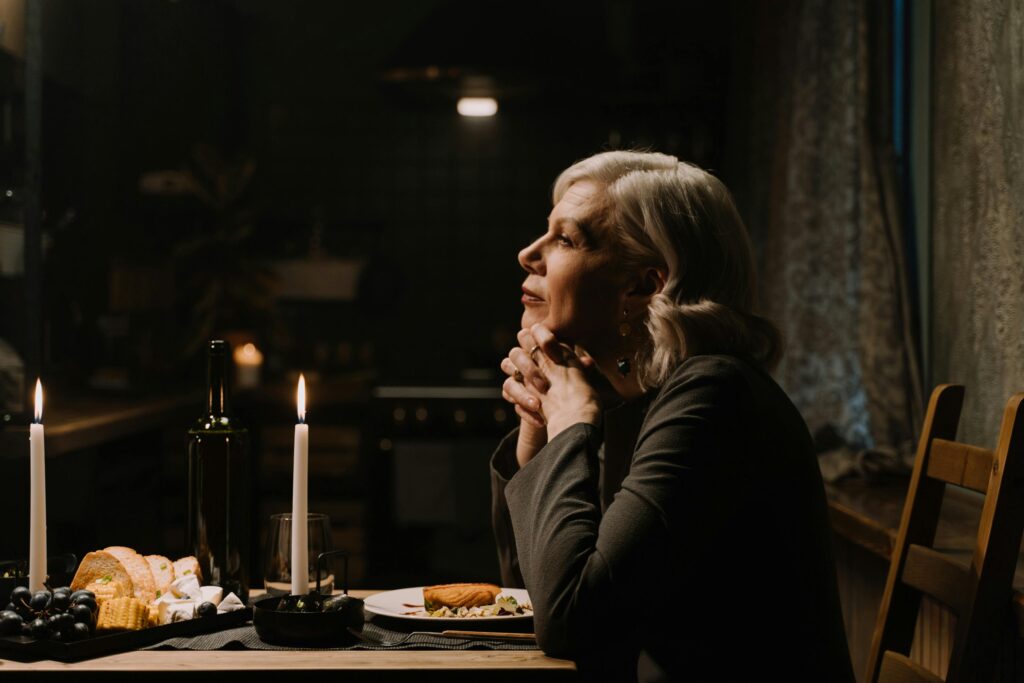
Not the meal you used to make for him. Not the dinner the kids loved. Not the recipe your mother passed down. What food, if no one else’s preference were a factor at all, would you choose to eat tonight?
Most women in their forties and fifties who have just come out of a long marriage cannot answer this question quickly. Many cannot answer it at all. They sit with it for a moment, and then realize they don’t actually know.
This is not a small thing. It is a diagnostic moment.
The blankness you feel when asked what you, specifically, want, is the felt experience of having spent decades inside a partnership where every preference was negotiated, every meal was a compromise, every Saturday was a joint plan. After enough years of that, your own preferences become so quiet that you can no longer hear them — even when no one else is in the room.
The thought I don’t know who I am after divorce is, very often, this. It is the moment your inner life finally has space, and you discover that you have not been keeping track of yourself in it.
How a Long Marriage Slowly Erases Your Preferences
I want to be careful here, because this is not a story about bad husbands or controlling marriages. It is something more universal and, in some ways, more difficult to see.
A long marriage produces identity erasure through a thousand small, ordinary compromises. None of them feel like erasure in the moment. Each one feels like love.
Think about what gets compromised over twenty-five or thirty years.
What music plays in the car. What temperature the house is kept at. What the rhythm of the evening looks like. What kind of vacation feels relaxing. What movies are worth watching. What time the lights go out. What side of the bed you sleep on. What kind of coffee is made in the morning. What gets ordered at the restaurant. Which friends you see and how often.
None of these are forced. Most of them are negotiated quietly, over years, in a way neither of you would describe as compromise. You like dim lighting; he prefers it bright. So the lamps end up at a middle brightness that suits no one in particular, but suits the marriage. Multiply that by a thousand small adjustments over decades, and what you end up with is a home calibrated for the two of you — and a self calibrated to disappear into the calibration.
This is the part almost no one names. The reason you don’t know what your favorite meal is now is not because the divorce damaged you. It is because the long marriage required you not to know, in order to function smoothly.
When the marriage ends, the negotiated middle ground stays in your bones. You walk into the kitchen alone, and the lamps are still at the dim-bright compromise neither of you would have chosen on your own. The coffee is still made the way you both agreed it could be made. The thermostat is still at the temperature you settled on.
You are surrounded by the architecture of compromise, and the question of what you would actually prefer — if no one else’s preference existed — has become so unfamiliar that asking it feels almost rude.
Why You Cannot Just “Decide” What You Like Now
Here is the cruel paradox at the heart of I don’t know who I am after divorce. The moment the marriage ends, you are technically free to choose anything. And the very moment you are free, you discover that choosing has become almost impossible.
You stand in front of the refrigerator and cannot decide what to eat. You sit on the couch and cannot decide what to watch. You go to a restaurant alone for the first time and cannot pick from the menu. Small decisions feel huge. Each one feels weighted.
This is not weakness. It is the predictable consequence of three converging forces.
The first is decades of decision-by-committee. Your nervous system has been trained for years to make decisions through negotiation, not declaration. The skill of just choosing, without checking, without consulting an internal model of what someone else would prefer, has atrophied. Like any atrophied skill, it cannot simply be turned back on. It has to be rebuilt.
The second is the cognitive load of perimenopause and the years that follow. If you are in any phase of the hormonal transition, you are already dealing with measurable changes in concentration, decision-making, and emotional regulation. Research shows that brain fog affects up to 60 to 70 percent of women in this stage. Adding the demand of suddenly making every decision alone, after years of shared cognition, lands on a system that is already taxed.
The third is the stakes feel impossibly high. After a major life rupture, almost every decision begins to feel like it might be another mistake you’ll regret. You ask yourself what to eat for dinner, and underneath the question is a much larger one: what if I get this wrong, too? The grocery store becomes existential. The simple act of choosing a meal becomes a referendum on whether you can trust your own judgment ever again.
None of this is character weakness. This is what happens when a self that was distributed across a partnership for decades is suddenly asked to operate alone.
The Hidden Loss Nobody Names
There is a layer of grief inside I don’t know who I am after divorce that almost no one talks about, and it is worth saying out loud.
You are not only grieving him. You are also grieving the woman you might have been if you had known your own preferences all along.
What music would have played in the car on those drives if you had chosen? Where would you have vacationed? What clothes would you have worn? What career might you have leaned into? What friends would you have kept? What food would have been on your plate, ordinary Tuesdays, for twenty-five years?
You cannot know. And you cannot get those years back. And that, more than almost anything else, is the loss that arrives in the quiet moments and has no name in the standard divorce literature.
I want to give it a name now, because un-named grief becomes background depression, and you deserve to know what you are actually mourning.
This is delayed identity grief, and it is one of the most common and least discussed components of long-marriage divorce. It is what you feel when you realize that some part of you has been on pause for two or three decades, and the pause was so slow and gentle that you didn’t notice it happening.
Naming it does not fix it. But it stops you from interpreting it as evidence that something is wrong with you. There is nothing wrong with you. You are grieving years you cannot get back, and the grief is appropriate, and it is allowed.
Why This Is Actually Good News, Even Though It Does Not Feel Like It
I am going to say something that may sound harsh, and I want to ask you to hold it gently while I explain.
Many women in long, intact marriages live to the end of their lives without ever knowing what their favorite meal is. Without ever knowing what music they alone would choose. Without ever testing what they would prefer if no one else’s preference existed.
This is not a tragedy for them. They are content in the calibration, and the question never becomes urgent enough to ask. For many people, that is a peaceful and complete life.
But you are now on the other side of that wall. The thought I don’t know who I am after divorce is the threshold of that crossing.
The end of a long marriage does not just take things from you. It also gives you something most people in long, stable partnerships never receive: the chance, in midlife or later, to find out who you would have been if your preferences had been allowed to develop in the open.
This is not a small gift. It is a kind of second adolescence — uncomfortable, disorienting, and slow, but yours. The reason it feels so much like loss in the early months is that the gift is wrapped in grief. The two are not separate. You cannot have the rediscovery without the rupture. If you want to look more deeply at what this space is for and how to protect it, I have written separately about silence after divorce and what it makes possible
I am not telling you to be grateful for the divorce. That is not the work. The work is to recognize that the question what do I actually want now has space to live, and that space is the beginning of something most women never get.
The Practice of Small Discoveries
The instinct, when you realize you don’t know who you are anymore, is to try to figure it out all at once. Take a personality test. Sign up for a retreat. Make a list of values. Find yourself.
This almost never works, and I want to tell you why.
Finding yourself is too abstract a goal for a nervous system that is also grieving, managing logistics, possibly co-parenting, possibly working full-time, and possibly going through perimenopause. The abstraction collapses under the weight of everything else. You cannot solve identity recovery in a weekend. The slower clinical reality is closer to three to five years, the same recovery arc described in research on gray divorce — and that is a feature of long-marriage recovery, not a failure of yours.
What does work, slowly and reliably, is a much smaller practice. I call it the practice of small discoveries, and it operates at a scale your tired nervous system can actually handle.
Here is how it works. For the next few weeks, you stop trying to figure out who you are. Instead, you make small choices — and you notice what you notice.
Tonight, choose what to eat without asking yourself what anyone else would have wanted. Don’t try to figure out what you “really” love. Just pick something, and pay attention to how it feels to be in your body while eating it. Some nights it will be unremarkable. Some nights you will realize, with surprise, that the thing you ordered for years because he liked it is actually not what you would have ever chosen alone.
In the morning, choose what music plays in the kitchen. Don’t optimize it. Don’t choose what you used to love before him. Just pick something today, and notice how it feels.
Repaint one room in a color he would not have chosen, if you can. Move the lamps. Move the furniture. Sleep on whichever side of the bed feels right tonight, not yesterday.
Each of these is tiny. None of them, alone, will reveal who you are. But the accumulation of hundreds of small choices, made without filtering for someone else’s preference, slowly produces something more important than a self-discovery weekend ever could: it produces data.
You start to have evidence about who you actually are. Not from a personality test. From your own preferences, finally allowed to speak in real time.
What Returns When You Practice Choosing Yourself
I want to tell you what most women begin to notice, somewhere between the third and the twelfth month of this practice, because it is one of the gentlest and most underdescribed parts of post-divorce recovery.
Things start to come back.
Music you had forgotten you loved before you met him. A genre of book you stopped reading because he found it boring. Clothing styles that felt like you in your twenties and got abandoned somewhere along the way. Foods you didn’t realize you missed. The desire for travel to places you’d never have agreed on together. Friendships from before the marriage that suddenly feel important again.
Nothing dramatic. Just a slow, quiet returning of preferences that had been on hold for so long you forgot they were yours.
This is the part of recovery that no one photographs, because there is nothing to photograph. There is no transformation moment. There is just a woman in her own kitchen, making a meal she actually likes, listening to music she actually chose, and realizing — without ceremony — that she is more herself than she has been in twenty-five years.
The reason this kind of return is so much more reliable than dramatic self-discovery is that it is built on a thousand small decisions, each one a small piece of evidence about you. By the time you notice the pattern, you have already built the new self. You just haven’t been keeping a journal about it.
The Day You Will Know
Somewhere down the road — and I cannot tell you exactly when, but it will come — someone will ask you what your favorite meal is.
You will not have to think about it. You will not have to pause and search. You will not have to wonder what the right answer is.
You will simply know.
The answer may surprise you. It may not be anything you would have predicted on the worst night of the divorce, when the question of I don’t know who I am after divorce was so loud you could not sleep. It may be something completely ordinary — a particular soup, a particular fish, a particular bread. The thought I don’t know who I am after divorce, which once filled the silence of your kitchen, will have quietly answered itself.
What will matter is not the answer. What will matter is that the answer is yours. Not a compromise. Not a negotiation. Not what you ate because someone else wanted it. Just yours.
And the moment you hear yourself say it out loud, you will know that you are not, in fact, lost. You were just buried for a while, very gently, under a life that asked you to disappear so quietly that even you didn’t notice. The asking has stopped now. The disappearance has stopped. And the woman underneath has been waiting all along.
FAQ
Why don’t I know what I like anymore after my divorce?
Because a long marriage involves thousands of small, invisible compromises over years or decades. Your preferences quietly recalibrated around the partnership until they became hard to access on their own. When the marriage ends, you are surrounded by the architecture of compromise, and your own preferences feel unfamiliar even though they are still inside you.
Is it normal to lose your identity in a long marriage?
Yes, and it happens to most women regardless of how happy or unhappy the marriage was. Identity merging in long partnerships is so gradual that neither partner notices it occurring. It is not a sign of weakness or of a bad marriage. It is the predictable consequence of decades of joint decision-making.
How long does it take to know yourself again after divorce?
For most women, the practice of small discoveries begins producing real clarity somewhere between three and twelve months in. Larger identity recovery — the kind where you actually know your favorite meal without thinking — typically takes two to four years. This is consistent with research on long-marriage divorce recovery generally, which finds full psychological recovery takes three to five years.
Can I really rediscover myself in my forties, fifties, or later?
Yes, and in many cases more deeply than would have been possible earlier. Research on midlife identity development shows that this stage of life is one of the most fertile periods for genuine self-discovery, precisely because you have accumulated decades of experience to draw on. You are not too late. You are arrived.
What if I am afraid of choosing for myself after my divorce?
This fear is normal and almost universal. After a major rupture, every decision feels high-stakes. The work is not to wait until the fear is gone — it never fully will be — but to make small, low-stakes choices anyway. Each small decision you make and survive becomes evidence that your judgment is intact. Confidence is rebuilt through action, not by waiting to feel ready.
Disclaimer
This article is for informational and educational purposes only and does not constitute medical, psychological, or legal advice. The content reflects my professional opinion as a licensed clinical psychologist and is not a substitute for individualized care. If you are in emotional crisis, please contact a qualified mental health professional or your local crisis line immediately.
Sources
- Kang HJ et al. Psychological well-being of midlife women: A structural equation modeling approach. Menopause. 2022. PMID: 35231003 — https://pubmed.ncbi.nlm.nih.gov/35231003/
- Runfola CD et al. Body image, aging, and identity in women over 50: The Gender and Body Image (GABI) study. J Women Aging. 2016. PMID: 27399268 — https://pubmed.ncbi.nlm.nih.gov/27399268/
- Kuck MJ, Hogervorst E. Stress, depression, and anxiety: psychological complaints across menopausal stages. Front Psychiatry. 2024. PMC10917984 — https://pmc.ncbi.nlm.nih.gov/articles/PMC10917984/
- Brown SL, Lin IF. The graying of divorce: A half century of change. J Gerontol B Psychol Sci Soc Sci. 2022;77(9):1710-1720. PMID: 35777731 — https://pubmed.ncbi.nlm.nih.gov/35777731/
- Maki PM, Jaff NG. Brain fog in menopause. Climacteric. 2022. https://www.tandfonline.com/doi/full/10.1080/13697137.2022.2122792