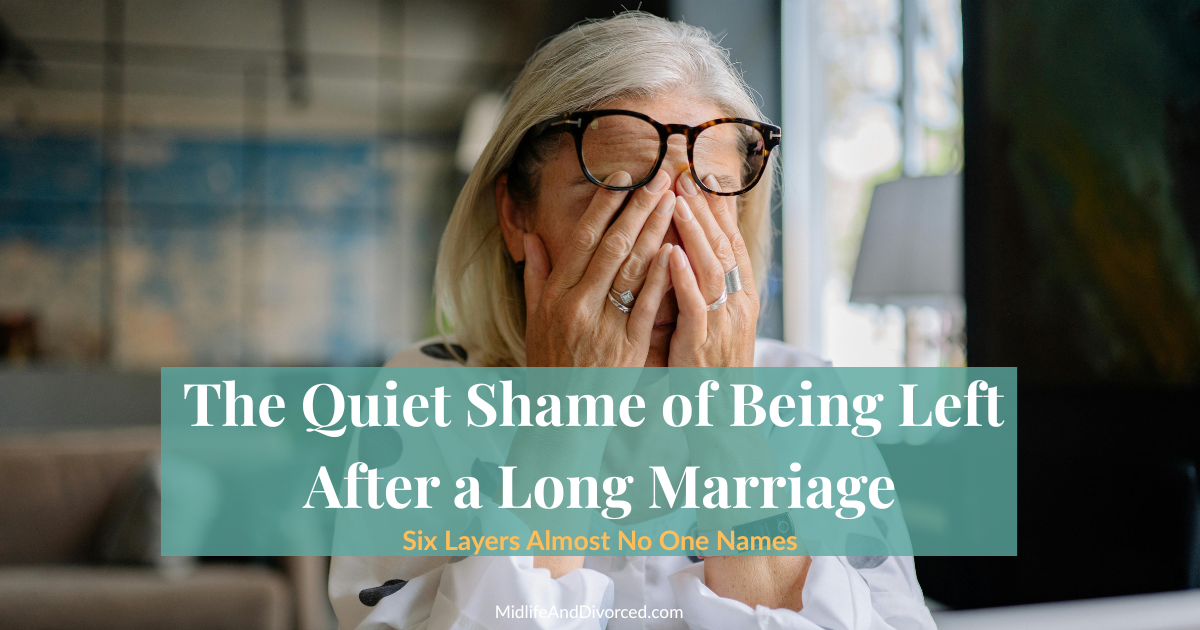
The Quiet Shame of Being Left After a Long Marriage: Six Layers Almost No One Names
TLDR
Guilt and shame after divorce — especially after a long marriage in which you were left for another woman — is not a sign that you are failing to cope. You are carrying at least six distinct layers of shame at once — most of them invisible, almost none of them named in the standard divorce literature.
This article names each of those layers honestly, explains where each one actually comes from, and shows you why the shame you feel is not evidence of who you are. It is evidence of how much was taken from you, and how publicly the taking happened.
Guilt and shame after divorce are among the heaviest secret burdens a woman can carry, and almost no one talks about them directly — especially not after a long marriage
The advice you find online is full of bright reassurances. You did nothing wrong. He’s the one who should be ashamed. You’ll come out stronger. These statements may be technically true, and they may feel completely useless when you are standing in line at the grocery store hoping no one you know walks by.
Real shame after being left, especially after being left for someone else, is not a single feeling. It is at least six different feelings stacked on top of each other, each one with its own root, each one needing to be named separately before any of them can begin to soften.
That is what this article does. It names them. Honestly, clinically, and without pretending the work is easier than it is.
You may recognize yourself in some layers and not others. That is normal. The point is not to feel everything at once. The point is to stop carrying what you cannot see.
Layer One: The Shame of Not Being Chosen
The deepest, most ancient layer of guilt and shame after divorce is also the simplest. He chose someone else. He did not choose you.
This is not a modern wound. The shame of not being chosen sits very deep in the human psyche, in places older than language. Brain imaging research on romantic rejection has shown that the experience of being chosen against activates the same neural circuits as physical pain — and the same circuits as withdrawal from substance addiction. This is not metaphor. The body of a woman who has been left is, neurologically, in a state of injury.
What makes this layer particularly cruel after a long marriage is that the rejection arrives at the end of decades of having been chosen, every day, in ten thousand small ways. Every shared meal. Every shared bed. Every shared decision. You did not just lose a marriage. You lost the long, accumulated proof that you were chosen.
Naming this is not the same as fixing it. But naming it stops you from interpreting the weight of this layer as a moral failure. The pain of not being chosen is not your weakness. It is the predictable response of an attachment system that did exactly what it was built to do.
Layer Two: The Shame of Being Replaced by Someone Younger
If your husband left for another woman — and especially if she is meaningfully younger — you are carrying a different shame than the woman whose husband simply left. This layer deserves its own name, because it operates on its own logic.
The shame of being replaced by someone younger is not vanity. It is the compounded weight of a culture that has been quietly telling you, for the last fifteen or twenty years, that your visibility is fading. The cosmetic ads for women your age are about hiding, smoothing, reversing.
The fashion industry stopped designing for your body somewhere in your forties. Public attention to women narrows sharply with age, and you have probably felt this shift in small ways for years.
When a husband leaves you for someone younger, what arrives is not just private rejection. It is the public confirmation of a verdict you have been resisting for years. The verdict that you are no longer in the running. That your value as a woman, by the only metric the culture seems to recognize, has expired.
Research on body image and identity in women in the second half of life consistently surfaces this exact theme: a sense of becoming invisible, of being dismissed, of disappearing from the cultural imagination. When your husband makes a younger choice public, this slow erosion suddenly has a face and a name.
I want to say this carefully and clearly. The shame you feel about being replaced by someone younger is not your character flaw. It is the culture finally landing inside your home. You did not invent the equation that says younger equals more valuable. You inherited it, like every woman before you. Naming it as inherited is the first step in beginning to refuse it.
Layer Three: The Shame of What Other People Think
This layer is the one most women describe first, even though it is rarely the deepest. It is the shame that activates at the grocery store, at family gatherings, at parents’ weekend at your child’s school, at the funeral of a mutual friend.
Someone asks how you are. You can hear the question underneath the question. I heard. Are you really okay? You look fine, but how are you really? And before you have answered, you feel your face get hot and your stomach drop and your voice go thin.
You wonder why. You did not do anything wrong. You were faithful. You showed up. You raised the children. You held the household. And yet when other people look at you, you feel the burn of judgment, even when no judgment is actually being offered.
Here is what is happening, and it is important. The guilt and shame after divorce that you feel in those moments is rarely about you. It is, more often, the projection of the other person’s fear.
When a woman in midlife sees another woman whose long marriage has just ended, she asks herself, almost involuntarily, could this happen to me? That question is uncomfortable. It threatens her sense of safety in her own marriage. To manage that discomfort, she sometimes — without meaning to — projects pity onto you. The pity she is feeling is a way of making the rupture feel like something that happened to a particular kind of woman, rather than something that could happen to anyone.
When you walk away from those conversations carrying the heat of shame, you are often carrying her fear, not your failure. The shame is not yours. It was handed to you in the produce aisle, and you are allowed to put it down.
Layer Four: The Shame of Having Been a Good Wife and Still Not Enough
This layer is, in my clinical experience, the most quietly destructive of all of them. It is the shame that says: I did everything right. I was faithful. I was loving. I was a good wife. And it still was not enough.
This is the shame that lives in the question you whisper to yourself at three in the morning. What is wrong with me, that being a good wife was not enough to keep him?
I want to be very direct here, because the answer matters. There is nothing wrong with you. The premise of the question is wrong. The premise is that being a good wife is supposed to be a guarantee against being left. It is not, and it never was. Being a good wife is a description of how you behaved inside the marriage. It is not a contract that binds the other person to stay.
A man who leaves a long marriage is making a decision about himself, not delivering a verdict on you. His decision can be disappointing, devastating, even infuriating. But it is not a measurement of your worth as a wife. The two things are not the same, even though everything in you wants them to be.
Many women in this layer of shame eventually come to a quiet, hard truth. The fact that you were a good wife does not protect you from this. But it also does not vanish. The years of love you gave were real. The home you built was real. The children you raised were real. None of that disappears because the marriage ended. None of that becomes worthless because he chose to leave. You did not lose what you were. You lost only what you assumed you would always have in return.
Layer Five: The Shame of a Body That Is Changing in the Worst Possible Moment
This is the layer almost no one writes about, and I think it is one of the cruelest. The body you are inside, at the very moment your husband leaves, is often a body that is also changing — and not in the directions the culture rewards.
If you are in perimenopause, postmenopause, or anywhere in the long hormonal transition that follows, you are managing a list of things you did not choose. Weight redistributing in places it never used to. Skin becoming thinner. Hair changing texture. Sleep disrupted. Brain fog affecting your concentration. Libido shifting. The face in the mirror increasingly belonging to a woman you do not always recognize.
In any other moment of life, you might have managed these changes with relative grace. But the moment your husband leaves — especially for someone younger — every one of those changes suddenly carries a new and unfair weight. You cannot tell whether you are grieving the marriage or grieving the body, because they collapse into each other.
The shame of a changing body in a moment like this is biochemically amplified. Estrogen fluctuations directly disrupt serotonin and dopamine, the neurotransmitters that regulate mood and self-perception. Research shows that 45 to 68 percent of women in the perimenopausal transition experience clinically significant depressive symptoms.
The voice in your head that is most cruel about your body right now is partly a hormonal voice, not the truth about you.
The work in this layer is not to suddenly love your body. That is a fantasy. The work is to recognize that the body did not betray you. The timing did. You are inside a season where every part of you is moving at once, and the rupture happened to land in the middle of it. Compassion for your body in this moment is not optional. It is medicine.
Layer Six: The Shame of Not Knowing Who You Are Anymore
The final layer is the deepest, and it usually emerges only after the first acute weeks have passed. It is the shame of looking at yourself and not knowing who you are without him.
For two or three or four decades, you were someone’s wife. Even if you had a career, friendships, a rich inner life of your own, the role of wife was woven into every assumption about your future. Your retirement was our retirement. Your home was our home. The shape of your social calendar was a shape made for two.
When the marriage ends, you do not just lose him. You lose the version of yourself that existed in relation to him. And what is left, in the early months, often feels like a stranger.
This is identity rupture, and it produces a particular shame that almost no one names. It is the shame of being grown, accomplished, capable — and feeling, somehow, like a teenager again. Not knowing what you want for breakfast. Not knowing what music to play in the empty house. Not knowing whether you actually like the friends you have, or only the friends he liked. Not knowing what you, alone, would choose.
This layer is not pathology. It is the natural consequence of having lived inside a partnership long enough that your selfhood and your role became braided together. The shame you feel at not knowing yourself is not evidence that you have no self. It is evidence that your self has been compressed for a very long time, and is only now beginning to expand back into its original shape.
That expansion takes time. It takes longer than the internet pretends. The first time you put on music you used to love before you met him and feel something familiar wake up in your chest, you will know what I mean. That moment will come. It is the beginning of the answer.
What to Do With Six Layers of Shame
Naming the layers is not the same as healing them, but it is the precondition for working with guilt and shame after divorce.
Most women I work with find that once they have named which specific layers of guilt and shame after divorce are loudest in them, the layers begin, very slowly, to lose some of their grip. Shame is the emotion that most depends on being unnamed. When you describe Layer Two to yourself in a sentence — this is the shame of being replaced, and it is the culture landing inside my home — the sentence does not erase the feeling, but it stops the feeling from running you.
A few practical anchors for the work ahead.
For Layer One (not being chosen) and Layer Two (being replaced), the most useful practice is not reassurance from others. It is understanding that these layers are responses of an attachment system and a culture, not measurements of you. They will fade with time and with the slow rebuilding of contexts in which your worth is not measured by his choice.
For Layer Three (what others think), the most useful practice is to identify, the next time you feel the heat of judgment in a public space, that the heat is often an inheritance from someone else’s fear. You do not have to carry it.
For Layer Four (good wife and still not enough), the most useful practice is separating the description of your behavior from the prediction of his. You can be a good wife. He can still leave. Those are two facts that can coexist without one negating the other.
For Layer Five (the changing body) and Layer Six (the lost self), the most useful practice is time and structure. These are the slowest layers, and they are the ones most likely to fade as you build a daily life with your own preferences, your own friendships, your own rhythms inside it.
I want to leave you with one more piece of honesty. The shame of being left after a long marriage does not fully go away in three months. It does not fully go away in a year. It softens, and softens, and one day you notice you have not felt it in a week. That week becomes a month. That month becomes most of your life.
You will not become unscarred. You will become a woman who carries the scar with much less weight than she once did. If you want a deeper look at why recovery from this kind of rupture takes longer than from other divorces, I have written separately about gray divorce and what the data actually says.
That is what healing actually is. Not the disappearance of what happened. The slow loosening of what it cost you.
FAQ
Why am I so ashamed of divorce after a long marriage when I did nothing wrong?
Because shame after a long marriage is rarely about what you did. It is about what was taken — the public role, the assumed future, the cultural visibility, the body’s place in the world. These are losses that the standard “you did nothing wrong” reassurance cannot reach. Naming the specific layers of shame, separately, is more effective than trying to argue your way out of the feeling.
Is it normal to feel ashamed when my husband left me for a younger woman?
Yes, and the shame in this specific situation is not vanity. It is the cumulative weight of years of cultural messaging about aging women combined with a private rejection. Most women in this situation describe a particular intensity of shame that is biochemically amplified by hormonal changes happening at the same time. You are not weak. You are inside a perfect storm.
How long does the shame last after being left?
There is no fixed timeline, but most women describe the most acute phase of shame lasting six to twelve months, with a slower fade over the next few years. Recovery from gray divorce, including the shame component, typically takes three to five years. If you are still feeling intense shame at the one-year mark, you are not behind. You are inside the normal arc.
How do I stop caring what other people think after my husband left?
You probably cannot stop caring entirely, and you do not need to. What you can do is recognize that the judgment you feel from others is often projection of their own fear that this could happen to them. Once you can name that pattern in real time, the heat of public encounters tends to ease, even if it never disappears completely.
Should I see a therapist for the shame I feel after my divorce?
If the shame is interfering with your sleep, your eating, your ability to function at work, or your relationships with your children, yes — please see a qualified therapist. Shame after long-marriage divorce can become entangled with depression and trauma responses, and these are well-treated with professional support. There is no minimum bar of severity. Caring for your mental health during this time is not weakness. It is intelligence.
Disclaimer
This article is for informational and educational purposes only and does not constitute medical, psychological, or legal advice. The content reflects my professional opinion as a licensed clinical psychologist and is not a substitute for individualized care. If you are in emotional crisis, please contact a qualified mental health professional or your local crisis line immediately.
Sources
- Fisher HE, Brown LL, Aron A, Strong G, Mashek D. Reward, addiction, and emotion regulation systems associated with rejection in love. J Neurophysiol. 2010;104(1):51-60. PMID: 20445032 — https://pubmed.ncbi.nlm.nih.gov/20445032/
- Eisenberger NI, Lieberman MD, Williams KD. Does rejection hurt? An fMRI study of social exclusion. Science. 2003;302(5643):290-292. PMID: 14551436 — https://pubmed.ncbi.nlm.nih.gov/14551436/
- Runfola CD et al. Body image, aging, and identity in women over 50: The Gender and Body Image (GABI) study. J Women Aging. 2016. PMID: 27399268 — https://pubmed.ncbi.nlm.nih.gov/27399268/
- Kuck MJ, Hogervorst E. Stress, depression, and anxiety: psychological complaints across menopausal stages. Front Psychiatry. 2024. PMC10917984 — https://pmc.ncbi.nlm.nih.gov/articles/PMC10917984/
- Brown SL, Lin IF. The graying of divorce: A half century of change. J Gerontol B Psychol Sci Soc Sci. 2022;77(9):1710-1720. PMID: 35777731 — https://pubmed.ncbi.nlm.nih.gov/35777731/